
Tuesday, December 15, 2009
Final Exam
Just a reminder: the final exam is Friday, December 18th, in our normal classroom. The 9:00 a.m. class's final begins at 9:00 a.m., and the 10:00 a.m. class's final begins at 10:00. You'll have 50 minutes to take it.

Sunday, December 13, 2009
12/14 Class Canceled
I'm sick, so Monday's class is canceled.
You can hand in paper #2 on either Wednesday (12/16) or Friday (12/18).
The final exam will still be Friday, December 18th, and we'll still be reviewing for it on Wednesday.

You can hand in paper #2 on either Wednesday (12/16) or Friday (12/18).
The final exam will still be Friday, December 18th, and we'll still be reviewing for it on Wednesday.
Saturday, December 12, 2009
Give Well
Here are some final links on giving to charity:

- Fancy word alert: Is giving to charity supererogatory?
- Here's an article on the reasons why we might give away the money we earn.
- There's so much food, but also so much hunger. Why?
- So you want to do good? Here's how to plan for it!
- Here are some thoughts on how to choose a charity to donate to (hint: don't just give to every walk-athon your friends ask you to).
Thursday, December 10, 2009
Stop the Aid?
Here's some stuff related to the James Shikwati interview we read for class.

- Shikwati's organization is online here. A similar organization you can donate to is online here.
- Zambian economist Dambisa Moyo agrees with Shikwati that current aid is doing more harm than good. Her book is called Dead Aid.
- The NPR program Fresh Air recently aired a radio interview with someone who agrees with Shikwati, but offers his own form of help.
- Here's an interesting article on many of the concerns Shikwati raises about giving aid to African nations. I especially recommend reading the last section of the article.
Wednesday, December 9, 2009
Peter Peter Charity Eater
Here's more than you ever wanted on Peter Singer:
- He has a new book called The Life You Can Save.
- Here he points out the biases that keep us from giving.
- Here he calls out professors for not teaching about poverty.
- Here he updates his argument and offers some specific giving guidelines.
- Here he defends his position against some tough questions.
- And here's his recent appearance on The Colbert Report .
Tuesday, December 8, 2009
Where to Give?
Here are some important links on relief aid:

- Free Charity! The Hunger Site. Just clicking there donates food! Also, try the word game at FreeRice.
- Affordable Charities! $10 Club, Microcredit, & Oxfam.
- Research on Effective Charities! Want to know which charities aren't squandering their donations? Check out Charity Navigator or GiveWell.
Monday, December 7, 2009
Paper #2 Guideline
UPDATE: New new due date!
Due Date: The beginning of class on Wednesday,December 2nd, December 9th, December 16th, 2009
Worth: 15% of your final grade
Assignment: Write an argumentative essay on the topic below. Papers must be typed, and must be between 600-1200 words long. Provide a word count on the first page of the paper. (Most programs like Microsoft Word & WordPerfect have automatic word counts.)
Topic: Explain and defend your definition of “person” as it relates to morality.

Due Date: The beginning of class on Wednesday,
Worth: 15% of your final grade
Assignment: Write an argumentative essay on the topic below. Papers must be typed, and must be between 600-1200 words long. Provide a word count on the first page of the paper. (Most programs like Microsoft Word & WordPerfect have automatic word counts.)
Topic: Explain and defend your definition of “person” as it relates to morality.
- First, briefly explain and critically evaluate the different definitions of “person” that we have discussed in class. Be sure to explain each definition offered by Mary Anne Warren, James Rachels (his account of a biographical life that we discussed in class), and Tibor Machan.
- Second, explain how each of these authors uses their definition of “person” to attempt to settle the particular ethical debate he or she wrote about. (Warren and Marquis on abortion, Rachels and Doerflinger on euthanasia, and Singer and Machan on animal ethics).
[NOTE: Some authors might think personhood is irrelevant to their issue.] - Third, explain your definition of “person”: do you agree with one of these authors’ definitions, or do you have one of your own?
- Fourth, explain the solution that your definition of “person” gives to the ethical debates of abortion, euthanasia, and animal ethics.
Monday, November 30, 2009
Crime and Punishment
While we're on the subject of capital punishment, here's some stuff on new research into punishment:
- Mark Kleiman, professor of public policy at UCLA, has a new book called When Brute Force Fails: How to Have Less Crime and Less Punishment. He argues that smaller, swifter punishments can greatly increase deterrence.
- Here's a review of When Brute Force Fails.
- Kleiman runs a blog called Same Facts.
- Here's a video dialogue about Kleiman's book:
Monday, November 23, 2009
Death Penalty Box
Here are some links related to our discussion of the death penalty:

- An encyclopedia of philosophy article on the death penalty.
- A large collection of resources on the ethics of capital punishment. I mean, wow.
- What's up with punishment in general? That's a big ethical issue.
- What about the financial cost of the death penalty? Although it's common sense to think that keeping a criminal in prison for life would cost more than putting her to death, some studies suggest that the opposite is true. The additional legal battles in death penalty cases may cost more than a life sentence.
- A nice article on measuring the reliability of the justice system. How often do courts convict the wrong person? How reliable is eyewitness testimony?
- Of course, for some death penalty opponents, it's not about whether innocent people are sentenced to death.
Thursday, November 19, 2009
Quiz #2
We're having another quiz! Quiz #2 is worth 7.5% of your overall grade, and will be held at the beginning of class on Monday, November 23rd. You'll have about 25 minutes to complete it. It will consist mainly of short answer questions, and will be on everything we've covered since the midterm:

- abortion (Warren and Marquis)
- euthanasia (Rachels and Doerflinger)
- animal ethics (Singer, Norcross, and Machan)
Wednesday, November 18, 2009
Can Death Harm Animals?
Here is a short post with some thoughtful analysis regarding the topic of our 2nd paper on the moral status of persons (specifically, on non-persons and killing animals):
I recommend reading it to help you start developing your own arguments on these issues for your paper.
I recommend reading it to help you start developing your own arguments on these issues for your paper.
Tuesday, November 17, 2009

Saturday, November 14, 2009
Moopheus
Here are some links on animal ethics:

- Vegetarians Still Love the Smell of Bacon
- David Foster Wallace: Consider the Lobster
- How to Cut Back on Meat Slowly
- What Is The Meatrix?
- What If We Could Make Pain-Free Animals?
- Animal Research (Peter Singer's Sometimes OK with It!)
- Peter Singer on Michael Vick & Dog Fighting
- Audio Interview with Peter Singer
- Michael Pollan's "An Animal's Place"
- Huge List of Resources on the Moral Status of Animals
Sunday, November 8, 2009
The Ethics of Killing
 I don't often recommend an entire book to students, but if you're interested in some thoughtful analysis of abortion, euthanasia, killing, and personhood, among other things, you should check out Jeff McMahan's The Ethics of Killing. Here's a short description of the book:
"This magisterial work is the first comprehensive study of the ethics of killing, where the moral status of the individual killed is uncertain. Drawing on philosophical notions of personal identity and the immorality of killing, McMahan looks carefully at a host of practical issues, including abortion, infanticide, the killing of animals, assisted suicide, and euthanasia."McMahan teaches philosophy at Rutgers. He also just wrote a follow-up book called Killing in War. I'm not saying I agree with everything in this book, but it's exactly the kind of careful, thought-out approach that I think complicated, serious issues deserve.
Friday, November 6, 2009
Extra Credit: The Box
Here's an optional extra credit assignment:
Go watch the new movie The Box and write a short (about one page) response to it. What did you think of the movie? What ethical issues did it raise? How might you react if you were given such a box? How should one react? Try to relate the movie to ethics, and especially what we've discussed in class.
Thursday, November 5, 2009
Friday, October 23, 2009
Midterm Reminder
Just a reminder: The midterm is Monday, October 26th. It's worth 15% of your overall grade, and will cover everything we've done in class so far:

- Doing Philosophy
- Understanding and Evaluating Arguments
- Are Moral Claims Fact-Based or Merely Opinions?
- Relativism
- Realism
- God Ethics (divine command theory)
- Happy Ethics (utilitarianism, John Stuart Mill reading)
- Kant's Ethics (Immanuel Kant reading)
Tuesday, October 20, 2009
Cookie Party!
 The 9:00 a.m. class is having a cookie party! Bake or buy cookies, cupcakes, pies, cakes, krimpets, or whatever you want. Then bring your baked goods to class on Friday, October 23rd. There's a Facebook Event invitation -- go join the event!
Sorry, 10:00 a.m. class, but this isn't for you. We can schedule a cookie party for our class some time in the future.
Sunday, October 18, 2009
Kant's a Tool
I thought it might help us all if I opened up a post dedicated solely to complaining about how tough the Immanuel Kant reading was. Leave your best Kant insults in the comments of this post.
[can't get enough Kant?]
[smitten by Deontological Ethics?]
[want tips on reading these articles?]

[can't get enough Kant?]
[smitten by Deontological Ethics?]
[want tips on reading these articles?]
Friday, October 9, 2009
Cookies & Wasps
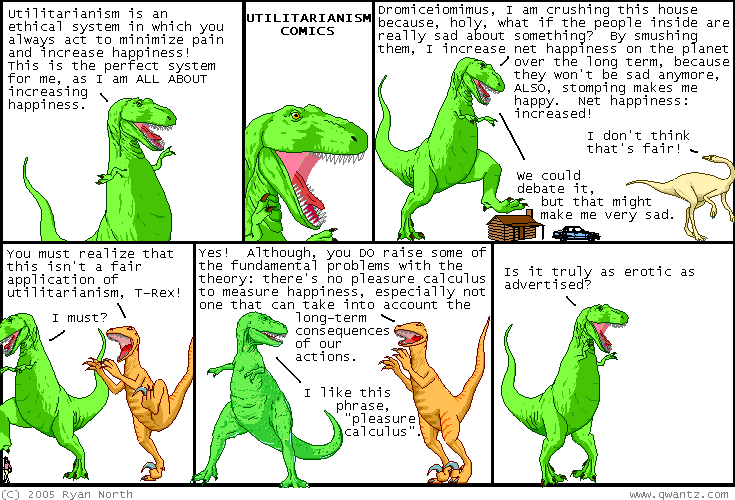
Here are some links that are loosely related to the stuff on happy ethics (utilitarianism) that we are studying.
- A neat little biography of know-it-all John Stuart Mill
- An advanced encyclopedia article on happy ethics and other theories that focus on consequences of an action
- There's a lot of psychological research on happiness popping up lately. Here's one overview of positive psychology. And here's a second one.
- There's an insightful, accessible book on the psychology of happiness called Stumbling on Happiness
- Recent studies suggest that our baseline level of happiness doesn't change much throughout our life. So, even if we won the lottery, we wouldn't wind up that much happier. This is potentially very depressing news, although some say there's room for some optimism, and others think the research is wrong.
- The trolley problem gets brought up a lot when evaluating happy ethics. There's some new research on the psychology of the trolley problem.

Wednesday, October 7, 2009
Consensus Groups: 10AM
Here are the groups for our consensus sessions in the 10:00 class, along with the article you're assigned to present on and the date you're presenting:

Euthanasia
-Group 1 on 11/06 (Rachels article - GRAY 306-310): Chris G., Eric, James, Mike
-Group 2 on 11/09 (Doerflinger article - GRAY pages 311-320): Andriy, Derek, Jim, Laura, Sarah P.
Animal Ethics
-Group 3 on 11/16 (Norcross article - GRAY 130-137): Andy, Chassity, Dan, Shannon
-Group 4 on 11/18 (Machan article - GRAY 138-150): Alexis, Brett, Danielle H., John, Robert
Death Penalty
-Group 5 on 11/25 (Pojman article - GRAY 203-210): Avni, Danielle K., Diana, Jovanka, LeTisha
-Group 6 on 11/30 (Bright article - GRAY 211-222): Chris B., Clay, Dominic, Jesse, Shaun
Relief Aid
-Group 7 on 12/07 (Singer article - GRAY 154-160): Christina, Kylie, Lauren, Ricky, Will
-Group 8 on 12/09 (Shikwati handout - available here): Alicia, Dominique, Megan, Sarah M.
Tuesday, October 6, 2009
Consensus Groups: 9AM
Here are the groups for our consensus sessions in the 9:00 class, along with the article you're assigned to present on and the date you're presenting:

Euthanasia
-Group 1 on 11/06 (Rachels article - GRAY 306-310): Andrew, Bulent, Joanne, Maria
-Group 2 on 11/09 (Doerflinger article - GRAY pages 311-320): Alex, Antonio, Dexter, Jared, Meghan
Animal Ethics
-Group 3 on 11/16 (Norcross article - GRAY 130-137): Brittany, Harry, Jack, Lauren
-Group 4 on 11/18 (Machan article - GRAY 138-150): Bruce, Laura, Sean C., Steve
Death Penalty
-Group 5 on 11/25 (Pojman article - GRAY 203-210): Adam, Derek, Mike, Ron
-Group 6 on 11/30 (Bright article - GRAY 211-222): Becca, Charity, Juli, Krista
Relief Aid
-Group 7 on 12/07 (Singer article - GRAY 154-160): Duong, John, Matt, Rob, Sam
-Group 8 on 12/09 (Shikwati handout - available here): Brian, Caitlin, Jake, Ken
Monday, October 5, 2009
Consensus Session Guidelines
In the second half of the semester we’ll be holding consensus sessions on whatever issues we’ll be discussing in class. Groups of about 4 students will be responsible for leading these consensus sessions. Your group’s assignment is to figure out the main argument from a specific article, then present that argument to your classmates in class. More specific directions are below:
Preparing for the Consensus Session
First, your group’s job is to understand and evaluate the argument contained in the readings for your issue.
Instructions for Running the Consensus Session
During your consensus session, your group’s job is to present your findings regarding the argument to the rest of the class, and lead a class-wide consensus session on each argument. Each group member should present about the same amount. Each session should last about 20-30 minutes.

Preparing for the Consensus Session
First, your group’s job is to understand and evaluate the argument contained in the readings for your issue.
1. Figure out the argument in your assigned article, and convert it into a clear premise/conclusion format.Your group must email me your version of the argument and evaluation of it one week before you’re scheduled to lead a session. I will provide helpful feedback, and make sure you’re on the right track.
2. Evaluate the argument as a group. Check each premise, and check the structure.
3. When evaluating, play the back & forth game. That is, consider as many responses to the argument and your criticisms of it as you can think of. Is the argument misguided? Mistaken? Can you revise the argument to overcome the criticisms you come up with?
4. Try to reach a group-wide consensus on your evaluation of the argument.
NOTE: It doesn’t matter which side you end up on! The goal isn’t to say what’s wrong about the argument. Nor do I want you to defend the argument no matter what. The goal is to figure out whether it’s good or bad.
Instructions for Running the Consensus Session
During your consensus session, your group’s job is to present your findings regarding the argument to the rest of the class, and lead a class-wide consensus session on each argument. Each group member should present about the same amount. Each session should last about 20-30 minutes.
1. Explain the main point of the reading.
2. Explain the author’s argument in support of this main point. (Explain it slowly and clearly, like you’re teaching it to the class. Point out exactly where each premise in your argument came from in the reading itself.)
3. Briefly explain your group’s evaluation of the author’s argument.
4. Explain how your group came to the conclusion that the argument is good/bad. Discuss the back & forth process you went through to come to your conclusion.
5. Hold a small question and answer round with the rest of class to explain and clarify the argument and your evaluation of it.
6. Run a consensus session (a thumbs up/thumbs down vote) with the rest of class where you evaluate each premise of the argument and the argument’s structure.
7. Go back & forth with every dissenter with the goal of trying to reach a consensus on each vote.
Wednesday, September 30, 2009
Paper #1 Guidelines
(Want tips on writing a philosophy essay? Check out here and here!)
Due Date: Friday, October 23rd, 2009
Worth: 5% of your overall grade
Assignment: Write an essay in which you support your opinion with an argument. Papers must be typed, and must be between 300-600 words long. Provide a word count on the first page of the paper. (Most programs like Microsoft Word have automatic word counts.)
Possible Paper Topics (Choose ONE of the following topics)
1. Defend a Theory. Out of the six ethical theories that we have studied—moral relativism, God ethics (divine command), happy ethics (utilitarianism), Kant’s ethical theory, Aristotle’s virtue ethics, or Gilligan’s ethics of care—which do you think is best? Why? What are some (at least two) of the best objections that someone might make to that theory? How would you reply to those objections to defend this theory? Explain & defend your position.
2. Criticize a Theory. Provide a detailed criticism of one of the six ethical theories we’ve discussed in class. First, briefly explain the theory, and present what you take to be the best argument in its favor. Then critically evaluate the argument. What are good objections to the argument? Consider how someone who supports the theory might respond to your objections, and explain why these responses are unsuccessful.
3. Facts, Opinions, & the Hitler Intuition. In class, we’ve discussed the “Hitler Intuition”: Many people want to say that Hitler’s moral beliefs were worse than ours, not just different from ours. Many use this intuition to argue against moral relativism, and support moral realism. Examine this intuition.

Due Date: Friday, October 23rd, 2009
Worth: 5% of your overall grade
Assignment: Write an essay in which you support your opinion with an argument. Papers must be typed, and must be between 300-600 words long. Provide a word count on the first page of the paper. (Most programs like Microsoft Word have automatic word counts.)
Possible Paper Topics (Choose ONE of the following topics)
1. Defend a Theory. Out of the six ethical theories that we have studied—moral relativism, God ethics (divine command), happy ethics (utilitarianism), Kant’s ethical theory, Aristotle’s virtue ethics, or Gilligan’s ethics of care—which do you think is best? Why? What are some (at least two) of the best objections that someone might make to that theory? How would you reply to those objections to defend this theory? Explain & defend your position.
2. Criticize a Theory. Provide a detailed criticism of one of the six ethical theories we’ve discussed in class. First, briefly explain the theory, and present what you take to be the best argument in its favor. Then critically evaluate the argument. What are good objections to the argument? Consider how someone who supports the theory might respond to your objections, and explain why these responses are unsuccessful.
3. Facts, Opinions, & the Hitler Intuition. In class, we’ve discussed the “Hitler Intuition”: Many people want to say that Hitler’s moral beliefs were worse than ours, not just different from ours. Many use this intuition to argue against moral relativism, and support moral realism. Examine this intuition.
-If you agree that it is solid evidence for moral realism, explain exactly how this intuition works. What makes it objectively true that Hitler was immoral? What is the basis of your judgment? In other words, what makes moral claims objectively true? Which ethical theory we’ve discussed do you think this supports? Explain and defend all your answers.4. Motives vs. Consequences. Which do you think is more important in determining whether an action is morally right or wrong: the consequences of the action (what happens as a result of the action), or the motivations behind the action (the reasons why someone chooses that action over other actions)? Why?
-If you do not believe that this intuition is solid evidence for objective morality, you are probably a relativist. Explain why this intuition doesn’t provide enough evidence for the existence of an objective morality. Why is it OK to say that Hitler’s actions weren’t universally bad? How is it that Hitler is simply bad to me, but not objectively bad?
-Describe an ethical theory that we have studied that cares more about the consequences of an action.5. Choose Your Own Adventure! Write on a topic of your choosing related to some or one of the ethical theories we’ve discussed in class. (Sean must approve your topic by Friday, October 16th.)
-Then describe an ethical theory that we have studied that care more about the motivations of actions.
-In arguing for one side over the other, describe a specific moral dilemma in which these theories would give different decisions based on the action’s consequences vs. its motivations. Be sure to fully explain and defend your position.
[NOTE: You can choose either side, as long as you defend it with a well-reasoned argument.]
Tuesday, September 29, 2009
God Stuff
Here are some links on God Ethics (divine command theory).

- An advanced overview of God Ethics, again from my favorite free online philosophy encyclopedia
- A quick explanation of the Euthyphro dilemma, the big criticism of God Ethics
- Lots of philosophy links related to the broader question of whether there is or is not a god
Tuesday, September 22, 2009
Quiz You Once, Shame on Me
The first quiz will be held at the beginning of class on Friday, September 25th. You will have about 25 minutes to take it. The quiz is worth 7.5% of your overall grade.
There will be two sections: the first section is on evaluating arguments, and will look just like the group work on evaluating arguments we did in class last week. There will also be a section of 4 short answer questions on the topic of moral relativism and realism (Are moral claims merely opinions or are they factually based?) These questions will be based on our class discussions of chapter 2 from the GRAY book and chapter 2 from the RED book.
Feel free to insult me in the comments for putting you through the terrible ordeal of taking a quiz.

There will be two sections: the first section is on evaluating arguments, and will look just like the group work on evaluating arguments we did in class last week. There will also be a section of 4 short answer questions on the topic of moral relativism and realism (Are moral claims merely opinions or are they factually based?) These questions will be based on our class discussions of chapter 2 from the GRAY book and chapter 2 from the RED book.
Feel free to insult me in the comments for putting you through the terrible ordeal of taking a quiz.
Sunday, September 20, 2009
Understanding Args
Here are the answers to the handout on understanding arguments that was assigned as optional extra credit.
1. (P1) Fairdale has the best team.
(C) Fairdale will win the championship
2. (P1) The housing market is depressed.
(P2) Interest rates are low.
(C) It's a good time to buy a home.
3. (P1) China is guilty of extreme human rights abuses.
(P2) China refuses to implement democratic reforms.
(C) The U.S. should refuse to deal with the present Chinese government.
4. (P1) The results of the Persian Gulf War were obviously successful for the U.S. military.
(C) The U. S. military is both capable and competent.
5. (P1) Scientific discoveries are continually debunking religious myths.
(P2) Science provides the only hope for solving the many problems faced by humankind.
(C) Science provides a more accurate view of human life than does religion.
6. (P1) Freedom of speech and expressions are essential to a democratic form of government.
(P2) As soon as we allow some censorship, it won't be long before censorship will be used to silence the opinions critical of the government.
(P3) Once we allow some censorship, we will have no more freedom than the Germans did under Hitler.
(C) We must resist all effort to allow the government to censor entertainment.
7. (P1) I'm very good at my job.
(C) I deserve a raise.
8. (P1) Jesse is one year old.
(P2) Most one-year-olds can walk.
(C) Jesse can walk.
9. (P1) The revocation of the 55 mph speed limit has resulted in an increased number of auto fatalities.
(C) we must alleviate this problem with stricter speed limit enforcement.
10. (P1) The last person we hired from Bayview Tech turned out to be a bad employee.
(C) I'm not willing to hire anybody else from that school again.
11. (P1) Maebe didn't show up for work today.
(P2) Maebe has never missed work unless she was sick.
(C) Maebe is probably sick today.
12. (P1) The United States, as the most powerful nation in the world, has a moral obligation to give assistance to people who are subjected to inhumane treatment.
(P2) The ethnic Albanians were being persecuted in Kosovo.
(C) It was proper for the U.S. to become involved in the air campaign against Kosovo.
----------------
Hat tip: I took some of the examples (with some revisions) from Beth Rosdatter's website , and some (with some revisions) from Jon Young's website .

1. (P1) Fairdale has the best team.
(C) Fairdale will win the championship
2. (P1) The housing market is depressed.
(P2) Interest rates are low.
(C) It's a good time to buy a home.
3. (P1) China is guilty of extreme human rights abuses.
(P2) China refuses to implement democratic reforms.
(C) The U.S. should refuse to deal with the present Chinese government.
4. (P1) The results of the Persian Gulf War were obviously successful for the U.S. military.
(C) The U. S. military is both capable and competent.
5. (P1) Scientific discoveries are continually debunking religious myths.
(P2) Science provides the only hope for solving the many problems faced by humankind.
(C) Science provides a more accurate view of human life than does religion.
6. (P1) Freedom of speech and expressions are essential to a democratic form of government.
(P2) As soon as we allow some censorship, it won't be long before censorship will be used to silence the opinions critical of the government.
(P3) Once we allow some censorship, we will have no more freedom than the Germans did under Hitler.
(C) We must resist all effort to allow the government to censor entertainment.
7. (P1) I'm very good at my job.
(C) I deserve a raise.
8. (P1) Jesse is one year old.
(P2) Most one-year-olds can walk.
(C) Jesse can walk.
9. (P1) The revocation of the 55 mph speed limit has resulted in an increased number of auto fatalities.
(C) we must alleviate this problem with stricter speed limit enforcement.
10. (P1) The last person we hired from Bayview Tech turned out to be a bad employee.
(C) I'm not willing to hire anybody else from that school again.
11. (P1) Maebe didn't show up for work today.
(P2) Maebe has never missed work unless she was sick.
(C) Maebe is probably sick today.
12. (P1) The United States, as the most powerful nation in the world, has a moral obligation to give assistance to people who are subjected to inhumane treatment.
(P2) The ethnic Albanians were being persecuted in Kosovo.
(C) It was proper for the U.S. to become involved in the air campaign against Kosovo.
----------------
Hat tip: I took some of the examples (with some revisions) from Beth Rosdatter's website , and some (with some revisions) from Jon Young's website .
Friday, September 18, 2009
Relative to You, But Not to Me
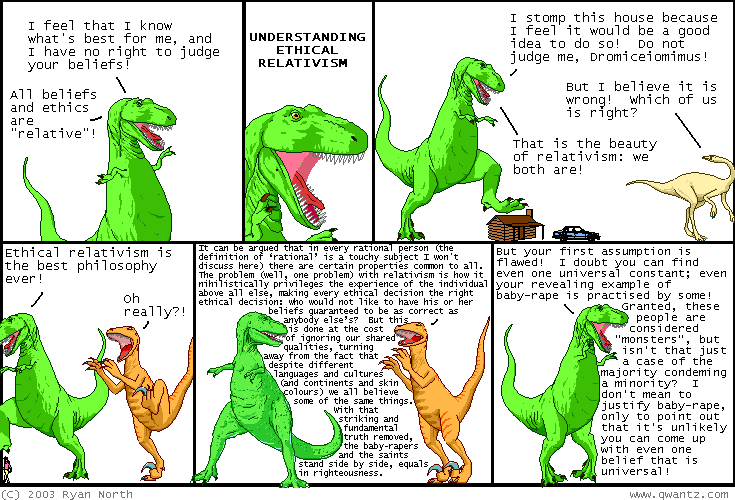
Here are some links on our first topic: are moral claims merely opinions or are they factually based?
- T-Rex says, "Beware of the relativist fallacy!"
- Cannibalism!
- INTERMEDIATE: a clarification of what moral relativism is and is not.
- ADVANCED: a detailed overview of various versions of moral relativism from my favorite free online philosophy encyclopedia.
- (Yes, there is more than one free online philosophy encyclopedia.)
- A cool interview with moral psychologist Jonathan Haidt who supports a version of moral relativism.
- A criticism of Haidt's defense of relativism.
- An argument against the DIVERSITY THESIS: in one sense, cultures morally agree more than they disagree.
- Who's to say what's right or wrong? How about philosophers?

Tuesday, September 15, 2009
Evaluating Args
Here are the answers to the handout on evaluating arguments that we did as group work in class. Perhaps I should have titled the handout "So Many Bad Args!"
1) All humpback whales are whales.
All whales are mammals.
All humpback whales are mammals.
Bush was either a great prez or the greatest prez.
Bush wasn’t the greatest prez.
Bush was a great prez.
Sean has a cat.
Sean's cat can speak German.
Some knock-knock jokes are funny.
Some annoying things are funny.
All whales live in the ocean.
All mammals live in the ocean.
All bearded people are mean.
Some dads are mean.
All boring things are taught by Sean
This class is taught by Sean.
All humans are mammals.
All students in this room are humans.
 9) All hornets are wasps.
All wasps are insects.
All insects are scary.
All hornets are scary.
All men are mammals.
All men are women.
Sean is singing right now.
Students are cringing right now.
Sean isn't singing right now.
Students aren't cringing right now.
Students aren't cringing right now.
Sean isn't singing right now.
Students are cringing right now.
Sean is singing right now.

1) All humpback whales are whales.
All whales are mammals.
All humpback whales are mammals.
P1- true2) (from Stephen Colbert)
P2- true
structure- good
overall - good
Bush was either a great prez or the greatest prez.
Bush wasn’t the greatest prez.
Bush was a great prez.
P1- questionable ("great" is subjective)3) Some cats can speak German.
P2- questionable ("great" is subjective)
structure- good (it's either A or B; it's not A; so it's B)
overall- bad (bad premises)
Sean has a cat.
Sean's cat can speak German.
P1- false4) All knock-knock jokes are annoying.
P2- true! (I have two; there they are! ------------>)
structure- bad (the 1st premise only says some can speak German; Sean's cat could be one of the ones that doesn't)
overall- bad (bad structure)
Some knock-knock jokes are funny.
Some annoying things are funny.
P1- questionable ("annoying" is subjective)5) All whales are mammals.
P2- questionable ("funny" is subjective)
structure- good (the premises establish that some knock-knock jokes are both annoying and funny; so some annoying things [those jokes] are funny)
overall - bad (bad premises)
All whales live in the ocean.
All mammals live in the ocean.
P1- true6) Some dads have beards.
P2- true (if interpreted to mean "Whales are the sorts of creatures whose natural habitat is the ocean.") or false (if interpreted to mean "Each and every living whale lives in the ocean," since some whales, like Shamu, live in SeaWorld or other zoos)
structure- bad (we don't know much about the relationship between mammals and creatures that living in the ocean just from the fact that whales belong to each of those groups)
overall- bad (bad structure)
All bearded people are mean.
Some dads are mean.
P1- true7) This class is boring.
P2- questionable ("mean" is subjective)
structure- good (if all the people with beards were mean, then the dads with beards would be mean, so some dads would be mean)
overall- bad (bad 2nd premise)
All boring things are taught by Sean
This class is taught by Sean.
P1-questionable ("boring" is subjective)8) All students in this room are mammals.
P2- false (nearly everyone would agree that there are some boring things not associated with your teacher Sean)
structure- good
overall- bad (bad premises)
All humans are mammals.
All students in this room are humans.
P1- true
P2- true
structure- bad (it's the same structure as argument #10 below; the premises only tell us that students and humans both belong to the mammals group; we don't know enough about the relationship between students and humans from this; for instance, what if a dog were a student in our class?)
overall- bad (bad structure)
9) All hornets are wasps.All wasps are insects.
All insects are scary.
All hornets are scary.
P1- true!10) All women are mammals.
P2- true
P3- questionable ("scary" is subjective)
structure- good (same structure as in argument #1, just with an extra premise)
overall- bad (bad 3rd premise)
All men are mammals.
All men are women.
P1- true11) If Sean sings, then students cringe.
P2- true
structure- bad (just because men and women belong to the same group doesn't mean that men are women; same bad structure as in arg #8)
overall- bad (bad structure)
Sean is singing right now.
Students are cringing right now.
P1- questionable (since you haven't heard me sing, you don't know whether it's true or false)12) If Sean sings, then students cringe.
P2- false (I'm not singing now!)
structure- good
overall- bad (bad premises)
Sean isn't singing right now.
Students aren't cringing right now.
P1- questionable (again, you don't know)13) If Sean sings, then students cringe.
P2- true
structure- bad (from premise 1, we only know what happens when Sean is singing, not when he isn't singing; students could cringe for a different reason)
overall- bad (bad 1st premise and structure)
Students aren't cringing right now.
Sean isn't singing right now.
P1- questionable (again, you don't know)14) If Sean sings, then students cringe.
P2- true
structure- good
overall- bad (bad 1st premise)
Students are cringing right now.
Sean is singing right now.
P1- questionable (again, you don't know)
P2- false
structure- bad (from premise 1, we only know that Sean singing is one way to guarantee that students cringe; just because they're cringing doesn't mean Sean's the one who caused it; again, students could cringe for a different reason)
overall- bad (bad premises and structure)
Wednesday, September 9, 2009
Club Meeting
 So, I run a club called "Owning Our Ignorance" that's devoted to fun and reasoning, but more funning than reasoning. Shut up, "funning" is too a word.
We're having our first meeting of the school year Sunday night at the Barnes & Noble in Deptford. More info on the meeting and the club are available here.
If you're interested, come on out!
Sunday, September 6, 2009
The 3-Year-Old Method
Here's comedian Louis CK's take on the broad, fundamental questions kids ask.
And here's what springs to my mind when I think about doing philosophy:

Louis CK - Why?
And here's what springs to my mind when I think about doing philosophy:
Wednesday, September 2, 2009
Email Subscription
So why does this course have a blog? Well, why is anything anything?
A blog (short for “web log”) is a website that works like a journal – users write posts that are sorted by date based on when they were written. You can find important course information (like assignments, due dates, reading schedules, etc.) on the blog. I’ll also be updating the blog throughout the semester, posting interesting items related to the stuff we’re currently discussing in class. You don't have to visit the blog if you don't want to. It's just a helpful resource. I've used a blog for this course a lot, and it's seemed helpful. Hopefully it can benefit our course, too.
Since I’ll be updating the blog a lot throughout the semester, you should check it frequently. There are, however, some convenient ways to do this without simply going to the blog each day. The best way to do this is by getting an email subscription, so any new blog post I write automatically gets emailed to you. (You can also subscribe to the rss feed, if you know what that means.) To get an email subscription:
1. Go to http://cccethics2009.blogspot.com.
2. At the main page, enter your email address at the top of the right column (under “EMAIL SUBSCRIPTION: Enter your Email”) and click the "Subscribe me!" button.
3. This will take you to a new page. Follow the directions under #2, where it says “To help stop spam, please type the text here that you see in the image below. Visually impaired or blind users should contact support by email.” Once you type the text, click the "Subscribe me!" button again.
4. You'll then get an email regarding the blog subscription. (Check your spam folder if you haven’t received an email after a day.) You have to confirm your registration. Do so by clicking on the "Click here to activate your account" link in the email you receive.
5. This will bring you to a page that says "Your subscription is confirmed!" Now you're subscribed.
If you are unsure whether you've subscribed, ask me (609-980-8367; slandis@camdencc.edu). I can check who's subscribed and who hasn't.

A blog (short for “web log”) is a website that works like a journal – users write posts that are sorted by date based on when they were written. You can find important course information (like assignments, due dates, reading schedules, etc.) on the blog. I’ll also be updating the blog throughout the semester, posting interesting items related to the stuff we’re currently discussing in class. You don't have to visit the blog if you don't want to. It's just a helpful resource. I've used a blog for this course a lot, and it's seemed helpful. Hopefully it can benefit our course, too.
Since I’ll be updating the blog a lot throughout the semester, you should check it frequently. There are, however, some convenient ways to do this without simply going to the blog each day. The best way to do this is by getting an email subscription, so any new blog post I write automatically gets emailed to you. (You can also subscribe to the rss feed, if you know what that means.) To get an email subscription:
1. Go to http://cccethics2009.blogspot.com.
2. At the main page, enter your email address at the top of the right column (under “EMAIL SUBSCRIPTION: Enter your Email”) and click the "Subscribe me!" button.
3. This will take you to a new page. Follow the directions under #2, where it says “To help stop spam, please type the text here that you see in the image below. Visually impaired or blind users should contact support by email.” Once you type the text, click the "Subscribe me!" button again.
4. You'll then get an email regarding the blog subscription. (Check your spam folder if you haven’t received an email after a day.) You have to confirm your registration. Do so by clicking on the "Click here to activate your account" link in the email you receive.
5. This will bring you to a page that says "Your subscription is confirmed!" Now you're subscribed.
If you are unsure whether you've subscribed, ask me (609-980-8367; slandis@camdencc.edu). I can check who's subscribed and who hasn't.
Monday, August 31, 2009
Course Details
Camden County College, Blackwood Campus
Philosophy 131
Fall 2009
Monday, Wednesday, and Friday
Section 03: 9:00 a.m. – 9:50 a.m. in Madison Hall, Room 311
Section 01: 10:00 a.m. – 10:50 a.m. in Madison Hall, Room 311
Philosophy 131
Fall 2009
Monday, Wednesday, and Friday
Section 03: 9:00 a.m. – 9:50 a.m. in Madison Hall, Room 311
Section 01: 10:00 a.m. – 10:50 a.m. in Madison Hall, Room 311
Instructor: Sean Landis
Email: slandis@camdencc.edu
Phone: 609-980-8367
Course Website: http://cccethics2009.blogspot.com
Required Texts
The Elements of Moral Philosophy, 6th Edition, James & Stuart Rachels (RED)
The Right Thing to Do, 5th Edition, James & Stuart Rachels (GRAY)
About the Course
This course is split into two halves: theory and practice. During the first half, we will study several ethical theories that attempt to answer broad questions about the nature of morality. What are the various ways that philosophers describe the difference between things that are morally right and wrong? Are the consequences of what we do more important than the motivation behind our actions, or vice versa? Does morality require God? Are ethical theories nothing more than cultural conventions?
In the second half of the course, we will apply these theories to particular ethical problems. Topics include abortion, euthanasia, the death penalty, famine relief, and animal rights. The goal of this course is to develop a philosophical understanding of what underlies moral claims and apply this understanding to our own ethical beliefs.

Grades
900-1000 points = A
800-899 points = B
700-799 points = C
600-699 points = D
below 600 points = F.
Midterm 150 points
Final 250 points
Quizzes (2) 75 points each (150 total)
Homework 50 points total
First Paper 50 points
Second Paper 150 points
Consensus Session 150 points
Attendance/Participation 50 points
Exams: The midterm tests everything covered during the first half of the course, and will last the full period (50 minutes) on the scheduled day. The final exam is cumulative—that is, it tests everything covered throughout the whole course. The final will also last 50 minutes, and be held on the last day of class.
Quizzes: Unlike the exams, quizzes will not be cumulative. Quiz #1 will test you on everything covered during the first 4 weeks of class, and quiz #2 will test you on everything we cover after the midterm. Quizzes will last 20 to 25 minutes, and be held at the beginning of the period on the scheduled day.
Consensus Session: This will be an in-class, group oral report. During the second half of the semester, we will be going over specific ethical debates. Each group of 3-5 students will be assigned to research the ethical topic that we’re discussing that week, present a short lesson on it to the rest of class, and run a voting session on the issue being debated.
Papers: There will be two papers, the first a short one on ethical theory and the second a longer one on one or more of the applied topics we discuss.
Homework: Homework assignments are due at the beginning of class the day they are due.
Attendance/Participation: Most of this will be based on your attendance. If you’re there every class, you’ll get full credit for your attendance grade. Also, there will be a lot of informal group work throughout the semester. Group work can impact your attendance grade.
Extra Credit: I like giving extra credit! I’ll be giving some official extra credit assignments throughout the semester. I’ll also be offering some extra credit points more informally during class time. Remind me about this if I slack off on dishing out extra credit points.
Classroom Policies
Academic Integrity: Cheating and plagiarism (using someone else’s words or ideas in a paper or assignment without giving credit to the source) will not be tolerated in the class. Students found guilty of either will definitely fail the exam or assignment—and possibly the entire class. FYI: I’m pretty good at catching plagiarists. I recommend not trying it!
Excused Absenses: Make-up exams, quizzes, in-class projects, and oral reports will only be rescheduled for any excused absences (excused absences include religious observance, official college business, and illness or injury – with a doctor’s note). An unexcused absence on the day of any assignment or test will result in a zero on that assignment or test.

Important Dates
September 1st: Last day to drop & receive a 100% refund.
September 16th: Last day to drop & receive a 50% refund.
September 23rd: Last day to sign up to audit a course.
December 4th: Last day to withdraw from Fall Classes.
Sunday, August 30, 2009
Course Schedule
September 2—4: Intro to Class / Doing Philosophy
Wednesday Introduction to Class (no reading)
Friday Intro to Doing Philosophy (optional: GRAY 1-20)
September 7—11: Arguments
Monday LABOR DAY (no class)
Wednesday Understanding Arguments (GRAY 21-28)
Friday Evaluating Arguments (group work) (no reading)
September 14—18: Relativism
Monday Are Moral Claims Facts or Opinions? (RED 14-21)
Wednesday Two Reasons for Relativism (RED 21-31)
Friday One More Reason for Relativism (no reading)
September 21—25: Religion & Morality
Monday Religion & Morality explained (RED 48-53)
Wednesday Religion & Morality evaluated (RED 57-61)
Friday QUIZ #1; Religion & Morality wrap-up (no reading)
September 28—October 2: Utilitarianism
Monday Utilitarianism explained | Mill (RED 97-108; GRAY 29-36)
Wednesday Utilitarianism evaluated (RED 109-116)
Friday Utilitarianism evaluated (RED 116-123)
October 5—9: Kant
Monday Kant’s Ethics explained (RED 124-129)
Wednesday Kant’s Ethics | Kant (GRAY 61-66)
Friday Kant’s Ethics evaluated (RED 129-135)
October 12—16: Virtue Ethics
Monday Virtue Ethics explained (RED 158-168)
Wednesday Virtue Ethics | Aristotle (GRAY 67-73)
Friday Virtue Ethics: evaluated (RED 168-172)
October 19—23: Ethics of Care/Review
Monday Feminism & the Ethics of Care explained (RED 146-157)
Wednesday Ethics of Care | Held (GRAY 78-84)
Friday PAPER #1 due; Ethics of Care wrap-up & review for Midterm (no reading)
October 26—30: Midterm / Abortion
Monday MIDTERM EXAM
Wednesday Abortion | Warren (GRAY 109-119)
Friday Abortion | Marquis (GRAY 85-91)
November 2—6: Abortion / Euthanasia
Monday Abortion wrap-up (no reading)
Wednesday Euthanasia | Rachels (GRAY 306-310)
Friday Euthanasia; CONSENSUS SESSION #1 (no reading)
.
November 9—13: Euthanasia / Animal Ethics
Monday Euthanasia | Doerflinger; CONSENSUS SESSION #2 (GRAY 311-320)
Wednesday Euthanasia wrap-up (no reading)
Friday Animal Ethics | Singer (GRAY 120-129)
November 16—20: Animal Ethics
Monday Animal Ethics | Norcross; CONSENSUS SESSION #3 (GRAY 130-137)
Wednesday Animal Ethics | Machan; CONSENSUS SESSION #4 (GRAY 138-150)
Friday QUIZ #2; Animal Ethics wrap-up
November 23—25: The Death Penalty
Monday Death Penalty | Pojman (GRAY 203-210)
Wednesday Death Penalty | CONSENSUS SESSION #5 (no reading)
Friday THANKSGIVING BREAK! (no class) (woo?)
November 30—December 4: Death Penalty / Relief Aid
Monday Death Penalty | Bright; CONSENSUS SESSION #6 (GRAY 211-222)
Wednesday PAPER #2 due; Death Penalty wrap-up (no reading)
Friday Relief Aid | Singer (GRAY 154-160)
December 7—11: Relief Aid
Monday Relief Aid | Engel; CONSENSUS SESSION #7 (GRAY 151-153)
Wednesday Relief Aid | Shikwati; CONSENSUS SESSION #8 (handout)
Friday Relief Aid wrap-up (no reading)
December 14—18: Review & Final
Monday Catch-up day (no reading)
Wednesday review for Final Exam
Friday FINAL EXAM

Wednesday Introduction to Class (no reading)
Friday Intro to Doing Philosophy (optional: GRAY 1-20)
September 7—11: Arguments
Monday LABOR DAY (no class)
Wednesday Understanding Arguments (GRAY 21-28)
Friday Evaluating Arguments (group work) (no reading)
September 14—18: Relativism
Monday Are Moral Claims Facts or Opinions? (RED 14-21)
Wednesday Two Reasons for Relativism (RED 21-31)
Friday One More Reason for Relativism (no reading)
September 21—25: Religion & Morality
Monday Religion & Morality explained (RED 48-53)
Wednesday Religion & Morality evaluated (RED 57-61)
Friday QUIZ #1; Religion & Morality wrap-up (no reading)
September 28—October 2: Utilitarianism
Monday Utilitarianism explained | Mill (RED 97-108; GRAY 29-36)
Wednesday Utilitarianism evaluated (RED 109-116)
Friday Utilitarianism evaluated (RED 116-123)
October 5—9: Kant
Monday Kant’s Ethics explained (RED 124-129)
Wednesday Kant’s Ethics | Kant (GRAY 61-66)
Friday Kant’s Ethics evaluated (RED 129-135)
October 12—16: Virtue Ethics
Monday Virtue Ethics explained (RED 158-168)
Wednesday Virtue Ethics | Aristotle (GRAY 67-73)
Friday Virtue Ethics: evaluated (RED 168-172)
October 19—23: Ethics of Care/Review
Monday Feminism & the Ethics of Care explained (RED 146-157)
Wednesday Ethics of Care | Held (GRAY 78-84)
Friday PAPER #1 due; Ethics of Care wrap-up & review for Midterm (no reading)
October 26—30: Midterm / Abortion
Monday MIDTERM EXAM
Wednesday Abortion | Warren (GRAY 109-119)
Friday Abortion | Marquis (GRAY 85-91)
November 2—6: Abortion / Euthanasia
Monday Abortion wrap-up (no reading)
Wednesday Euthanasia | Rachels (GRAY 306-310)
Friday Euthanasia; CONSENSUS SESSION #1 (no reading)
.
November 9—13: Euthanasia / Animal Ethics
Monday Euthanasia | Doerflinger; CONSENSUS SESSION #2 (GRAY 311-320)
Wednesday Euthanasia wrap-up (no reading)
Friday Animal Ethics | Singer (GRAY 120-129)
November 16—20: Animal Ethics
Monday Animal Ethics | Norcross; CONSENSUS SESSION #3 (GRAY 130-137)
Wednesday Animal Ethics | Machan; CONSENSUS SESSION #4 (GRAY 138-150)
Friday QUIZ #2; Animal Ethics wrap-up
November 23—25: The Death Penalty
Monday Death Penalty | Pojman (GRAY 203-210)
Wednesday Death Penalty | CONSENSUS SESSION #5 (no reading)
Friday THANKSGIVING BREAK! (no class) (woo?)
November 30—December 4: Death Penalty / Relief Aid
Monday Death Penalty | Bright; CONSENSUS SESSION #6 (GRAY 211-222)
Wednesday PAPER #2 due; Death Penalty wrap-up (no reading)
Friday Relief Aid | Singer (GRAY 154-160)
December 7—11: Relief Aid
Monday Relief Aid | Engel; CONSENSUS SESSION #7 (GRAY 151-153)
Wednesday Relief Aid | Shikwati; CONSENSUS SESSION #8 (handout)
Friday Relief Aid wrap-up (no reading)
December 14—18: Review & Final
Monday Catch-up day (no reading)
Wednesday review for Final Exam
Friday FINAL EXAM
Subscribe to:
Posts (Atom)